There is no body, nor a world to contain it; there is only a mental condition, a dreamlike state, easy to dispel by questioning its reality.
Sri Nisargaratta Maraj
Beyond the Soul: What Quantum Physics Reveals About the Fabric of Existence
Humanity has long been haunted by a fundamental question: What makes us alive, and what remains when we are gone?
Across millennia, human cultures developed two profound philosophical frameworks to answer this mystery long before modern laboratories existed:
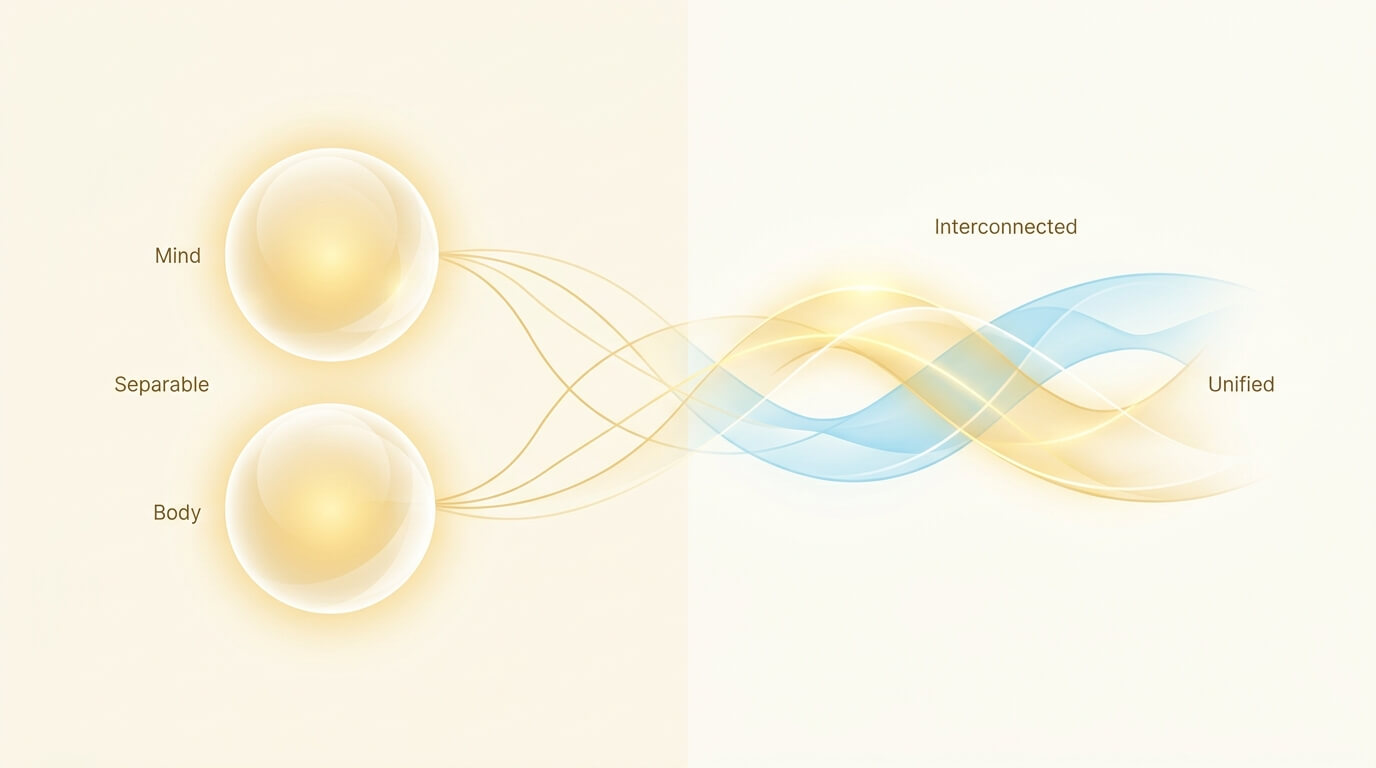
- The Soul (Dualism): Proposes that reality is split into two distinct parts—the physical body and an immortal, non-physical mind or spirit that inhabits it.
- One Substance (Monism): Asserts that all existence—matter, mind, space, and time—is merely a localised expression of a single, indivisible, underlying reality.
While early dualism sought to protect personal identity, the concept of “One Substance” merged all existence into an interconnected whole. Today, modern quantum mechanics provides a definitive scientific lens through which to evaluate both ancient ideas.
Part 1: The Historical Evolution of Dualism and Monism
The Birth of Dualism: Breath, Spirit, and the Soul
The earliest notions of an independent soul stemmed from direct biological observation: when a creature dies, its physical structure remains, but its breath departs.
- Ancient Linguistics: In early Hebrew texts, Nefesh signified a living, breathing creature, while Ruach referred to “wind” or “breath”. Traditional Chinese philosophy similarly divided the spirit into the Po (earthly body soul) and Hun (ethereal breath soul).
- Ancient Egypt: Spiritual existence was split into distinct constituent parts, including the Ka (the life force sustained by nourishment) and the Ba (the individual personality that took flight after death).
- Classical Greek Dualism: Plato argued that reality is split between the decaying physical world and the eternal Realm of Forms, viewing the soul (psyche) as an immortal entity trapped in a physical body. Conversely, his student Aristotle proposed hylomorphism, arguing that body (matter) and soul (form) are inherently inseparable.
The Emergence of Substance Monism
Unsatisfied with dualism, thinkers questioned how two completely different realities—spirit and matter—could interact. Must reality not ultimately consist of a single underlying substance?
- Pre-Socratic Philosophy: Around 600 BCE, Parmenides posited that all existence is actually a single, unchanging, indivisible unity called “Being”.
- Eastern Monism (Advaita Vedanta): Formalised by Adi Shankara in the 8th century, Advaita Vedanta teaches Brahman—the single, absolute reality. The individual soul (Atman) is not separate from the cosmos; individual identity is an illusion (maya).
- Spinoza’s Pantheism: In the 17th century, Baruch Spinoza countered Cartesian dualism by arguing there can logically be only One Substance in the universe—Deus sive Natura (“God or Nature”). Matter and thought are not two distinct entities, but attributes of the same underlying reality.
Core Comparison: Dualism vs Substance Monism
| Feature | The Concept of the Soul | The Concept of One Substance |
| Philosophical Basis | Dualism / Pluralism | Monism / Pantheism |
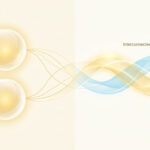
| Core View | You are an individual, immortal spirit distinct from your physical body. | All matter, mind, space, and life are temporary expressions of a single reality. |
| Personal Identity | Enduring: Your identity survives death and remains uniquely yours. | Interconnected: Identity is like a single wave on a vast ocean. |
| Core Problem Solved | Death, personal accountability, and subjective experience. | The fundamental unity of the universe and mind-matter interaction. |
Part 2: What Quantum Physics Actually Says
When we separate popular myth from scientific consensus, quantum theory offers a clear verdict: it strongly challenges traditional notions of an independent soul, while offering powerful support for the concept of One Substance.
1. Why Mainstream Physics Remains Sceptical of the Soul
The traditional concept of an immaterial soul that inhabits the body and survives death faces immense hurdles under modern physics:
- Conflict with Quantum Field Theory (QFT): For an immaterial soul to influence physical movement or thought, it would need to alter physical particles in the brain. According to QFT, all matter and forces behave according to precise, measurable rules. High-precision experiments have consistently ruled out any undetected forces interacting with human biology.
- Quantum Consciousness Hypotheses: Theories like Orch-OR (hypothesised by Sir Roger Penrose and Stuart Hameroff) suggest consciousness originates from quantum computations inside brain microtubules. Others suggest consciousness is preserved via quantum unitarity.
- The Decoherence Problem: The broader scientific community remains sceptical. The human brain is warm, wet, and noisy—an environment that causes rapid quantum decoherence. Fragile quantum states decay into ordinary classical physics far too quickly to sustain conscious processing.
2. Quantum Monism: Evidence for Fundamental Unity
In contemporary philosophy of science, quantum physics provides robust support for Substance Monism—often referred to as Quantum Holism or Priority Monism:
- Quantum Entanglement: Entanglement proves that two or more particles can become so fundamentally linked that they can no longer be described as separate entities, regardless of distance. They behave as a single, unified system.
- Quantum Fields: Subatomic particles are not solid, isolated objects. An electron is simply a localised ripple in a universal electron field spanning the entire cosmos. Every electron in your body is a vibration in the exact same field as an electron in a distant galaxy.
- The Universal Wave Function: Mainstream interpretations of quantum mechanics imply that the entire universe is governed by a single, global wave function. Individual objects—stars, trees, and human bodies—are not fundamental, independent substances, but localised, temporary expressions of one underlying quantum state.
Conclusion: A Paradigm Shift for Existence
Modern physics does not dismiss our deep-seated intuition of purpose or connection—it simply reframes it. Where classical philosophy sought to safeguard individuality by severing the soul from the physical body, quantum mechanics reveals that reality is far more profoundly unified than dualist models ever imagined.
By demonstrating that subatomic particles are localised fluctuations of universal fields, and that entangled states transcend classical boundaries of distance, contemporary physics aligns remarkably well with the core principles of Substance Monism. We are not isolated, immaterial minds piloting biological machines through a foreign universe; we are localised expressions of the cosmos experiencing itself. In the end, science and ancient philosophy converge on a single, compelling reality: the fundamental fabric of existence is indivisible, deeply interconnected, and whole.
Key Takeaways
- Ancient Dualism vs Substance Monism: Philosophy historically split into two views—Dualism (which posits an immaterial soul separate from the physical body) and Substance Monism (which views all mind, matter, and space as expressions of a single underlying reality).
- The Physics Challenge to Dualism: Mainstream physics remains sceptical of a separate, immaterial soul because Quantum Field Theory leaves no room for unaccounted forces interacting with human biology, and the brain’s warm environment causes rapid quantum decoherence.
- Quantum Support for Fundamental Unity: Phenomena such as quantum entanglement, universal quantum fields, and the global wave function provide strong scientific support for Substance Monism (Quantum Holism).
- Localised Expressions of a Whole: Quantum theory suggests individual objects and beings are not isolated entities, but localised, temporary vibrations within universal fields that span the entire cosmos.
Continue Your Journey Beyond the Concepts
Understanding non-duality intellectually is only the first step; moving beyond mental models into direct experience is where true integration happens. Whether you are seeking to dissolve limiting conditioning, deepen your understanding of awareness, or explore subtle energy practices, I offer several spaces to support your path:
Individual 1-on-1 Sessions: Tailored private consultations combining spiritual counselling, energy realignment, and direct inquiry to help you move past conceptual traps and return to wholeness.
Transformational Workshops: Experiential group workshops held online and in London, designed to explore awareness, inner healing, and energy work in a safe, guided environment.
Accredited Reiki Courses & Diploma Training: Comprehensive Reiki training (from Level 1 through to Master Teacher diploma) to help you connect deeply with universal energy for self-healing or professional practice.