Are They My Feelings? What Neuroscience and Quantum Psychology Say About Emotions
We tend to speak about emotions as if they are unexpected visitors. Fear seized me. Anger overtook him. Joy washed over her.
For decades, classical psychology reinforced this view. The popular narrative was simple: we have ancient, hardwired “emotion circuits” buried deep within our brain—often blamed on the amygdala or the “lizard brain”—that fire off automatically whenever external triggers occur. Under this view, feelings are universal reactions that simply happen to us.
However, modern neuroscience presents a very different—and far more empowering—picture.
If you have ever caught yourself reacting intensely to a situation and wondered, “Where did that come from? Are these even my feelings?” researchers actually have a surprising answer: Yes, they are yours—because your brain actively built them.
The Shift: From Reactive to Predictive Brains
For a long time, scientists believed the brain was a reactive machine: it receives input from the outside world, processes it, and outputs a feeling or action.
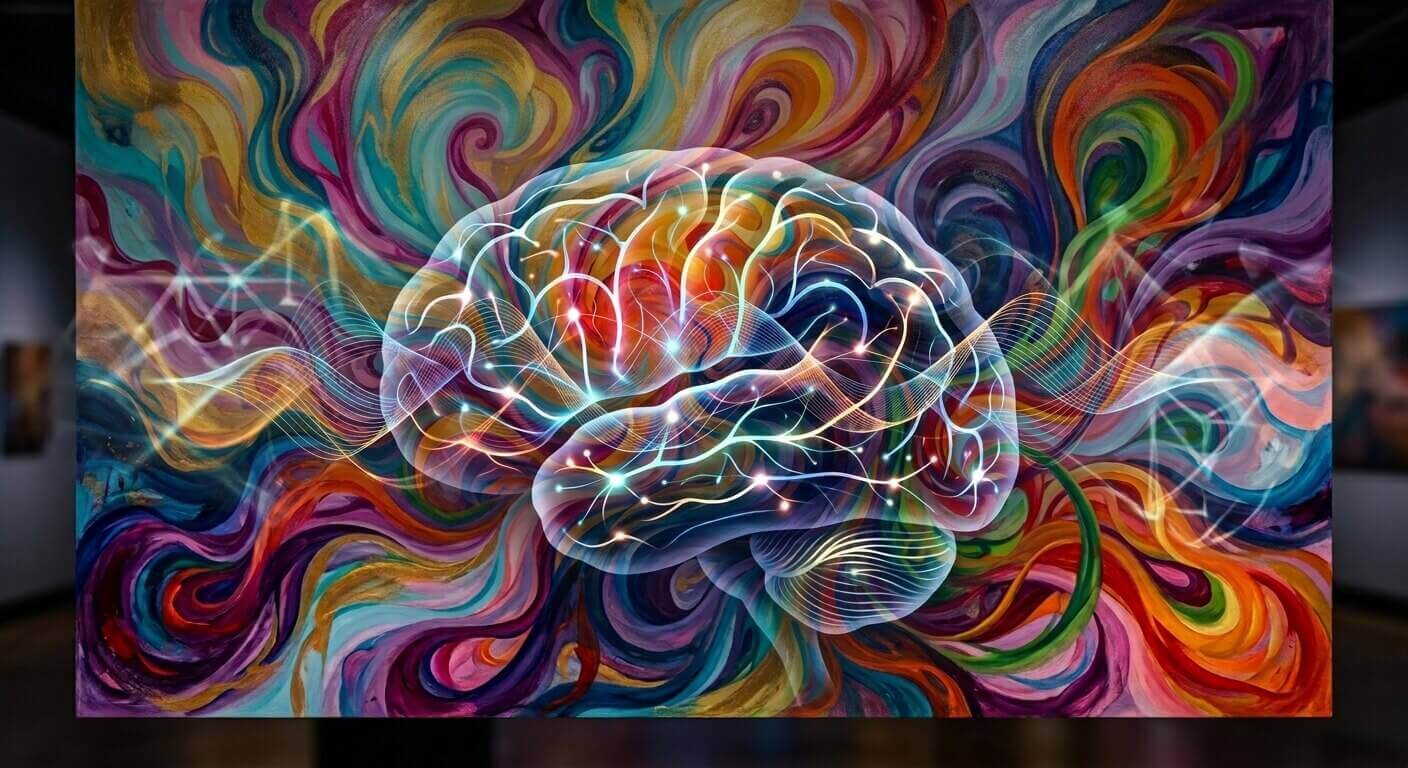
Recent breakthroughs in affective neuroscience—led prominently by researchers like Dr Lisa Feldman Barrett and her Theory of Constructed Emotion—show that the brain is actually a predictive organ.
Your brain sits in a dark, silent skull. It receives continuous streams of ambiguous sensory data from two places:
- The outer world: sights, sounds, smells, and social cues.
- Your inner world (interoception): heart rate, lung expansion, muscle tension, and stomach flutterings.
Because a racing heart could mean you are terrified, excited, or just had too much coffee, your brain cannot afford to wait and react. Instead, it constantly uses past experiences, context, and learned concepts to predict what those bodily sensations mean right now.
When your brain links a set of physical sensations to a specific situation using past knowledge, it constructs an instance of emotion.
The Ingredients of a Feeling
According to modern neuroscience, emotions aren’t pre-packaged reflexes waiting to be triggered. They are constructed in real time out of three core ingredients:
1. Interoception (The Body’s Signals)
Your brain constantly monitors the internal state of your body to manage energy budgets (a process known as allostasis). This produces a baseline feeling called core affect, which exists on two simple spectrums: pleasant versus unpleasant, and high energy versus low energy.
2. Context
A sudden spike in heart rate and adrenaline means one thing when you are sitting in a quiet boardroom before a speech, and another thing entirely when you are riding a roller coaster. The brain evaluates the environment to figure out what is happening around you.
3. Emotion Concepts (Language and Past Experience)
To turn raw physical arousal into a specific emotion, your brain relies on concepts you have learned throughout your life. Words like anxiety, gratitude, frustration, or awe act as mental blueprints.
If your chest tightens before a major test, your brain might classify that sensation as “anxiety” based on past academic stress. Change the conceptual label to “readiness” or “focus”, and the physical experience itself can shift.
A Quantum Lens on Emotion: Science vs Metaphor
In recent years, fields like quantum psychology have also entered the conversation about how we experience reality. Popularised by figures like Robert Anton Wilson and thinkers exploring the intersection of physics and mind, quantum psychology asks: Could quantum mechanics explain how our consciousness shapes our feelings?
When exploring this perspective, it is critical to distinguish between hard empirical science, mathematical modeling, and philosophical metaphor.
1. The Hard Science: Classical Neuroscience
Mainstream neuroscience operates on classical biochemistry and electrophysiology. Neural firing, neurotransmitter release, and synaptic plasticity explain how signals move through the brain.
While theoretical proposals like quantum cognition or orchestrated objective reduction (Orch-OR) suggest quantum processes might occur within brain structures like microtubules, these remain unproven hypotheses. The biological brain is warm, wet, and noisy—an environment where quantum coherence usually collapses in fractions of a second.
2. The Formal Bridge: “Quantum-Like” Cognitive Models
In decision theory and mathematical psychology, researchers use the formalism of quantum mathematics (without claiming the physical brain runs on quantum mechanics).
In classical logic, your opinion on point A should not change point B. In human emotion, however, asking someone “Are you anxious?” can actively change whether they feel anxious. Because human feelings depend so heavily on order, context, and observation, researchers use quantum mathematical equations to model how emotional states shift unpredictably—capturing the fluidity of human experience far better than classical logic.
3. The Philosophical Metaphor: Quantum Concepts as Mental Tools
When quantum psychology speaks of the “Observer Effect” (the idea that observing a particle alters its state) or “Superposition” (a system existing in multiple potential states until measured), it offers valuable metaphors for self-awareness:
- The Superposition of Feelings: Before your brain constructs a definitive emotion, your body experiences raw, unlabelled physiological arousal. You exist in a “superposition” of potential outcomes—you could interpret that chest tightness as excitement, fear, or simply caffeine.
- The Observer Effect in Mindfulness: Directing conscious attention to a feeling acts like an observation that “collapses” vague bodily sensations into a concrete emotional experience. Observing a feeling non-judgmentally can change the very nature of that feeling.
While these parallels are not physical proofs that your brain is a quantum computer, they serve as useful mental models for understanding how perception shapes reality.
Why Do Feelings Sometimes Feel Unfamiliar or Intrusive?
If we construct our own emotions, why do they often feel like sudden invasions?
- The brain works faster than conscious thought: Most predictive modelling happens in milliseconds beneath conscious awareness. By the time you notice a feeling, the prediction loop is already complete.
- Cultural and social conditioning: We inherit emotion concepts from our upbringing, culture, and social environment. Sometimes, an emotional response is a prediction based on old rules or societal expectations that no longer fit who you are today.
- Interoceptive misinterpretation: Physical states like fatigue, dehydration, low blood sugar, or hormonal shifts alter your core affect. Your brain, seeking to explain why you feel uncomfortable, might manufacture an emotion—like irritation at a partner—when your body really just needed water or rest.
Can I “Absorb” Other People’s Emotions? Scientific and Psychological Origins
The feeling of ‘absorbing’ other people’s emotions isn’t a magical or mystical phenomenon. It actually comes from how our brain works and how we evolved.
- Mirror neurons: Special nerve cells in our brain fire both when we do something and when we watch someone else do it. When we see someone looking sad, scared, or smiling, these cells recreate that same feeling inside us so we can understand what they’re going through.
- Emotional contagion: This is an automatic, subconscious habit. From the time we’re babies, we naturally copy the facial expressions, posture, tone of voice, and breathing of those around us. By copying their body language, our brain ends up feeling the same emotion.
- Survival value: In early human history, picking up on fear or danger instantly helped keep the group alive. If a member of a tribe saw a predator and felt terrified, others ‘absorbing’ that fear allowed everyone to run away without delay.
- The role of interoception: Our brain reads physical signals in the body to work out how we feel. When we start tensing our muscles or breathing heavily to match the person in front of us, our brain interprets those physical changes as: ‘I’m feeling this exact emotion, too.’
- Highly Sensitive People (HSP) and empaths: Some people are simply more aware of social and environmental cues. For them, the line between their own body’s reactions and someone else’s is thinner, which makes them feel strongly like ’emotional sponges’.
The Takeaway: Rewiring Your Emotional Architecture
The realisation that emotions are constructed—not wired in—is one of the most liberating findings in modern brain science. It means you are not a passive victim of your feelings.
Whether viewed through the lens of neuroscience or the philosophical models of quantum psychology, the practical outcome is the same: you have agency over your emotional experience.
Because the brain relies on concepts and past experiences to construct emotion, you can actively shape how you feel over time:
- Build Emotional Granularity: Learn more nuanced words for how you feel. Instead of just saying you feel “bad”, distinguishing between disappointed, overwhelmed, or pessimistic gives your brain more precise tools to regulate physical states.
- Check the Body First: Before accepting a sudden wave of anxiety or anger as an absolute truth, check your baseline. Are you sleep-deprived? Hungry? Overstimulated?
- Reframe the Physical Signals: A pounding heart before a challenge isn’t proof that you are afraid; it is your body marshalling oxygen and energy to help you succeed.
Your emotions are authentic, real, and vital. But they aren’t immutable forces acting upon you—they are flexible predictions created by a brain designed to keep you safe and alive. You are the architect of that process.
Continue Your Journey Beyond the Concepts
Understanding non-duality intellectually is only the first step; moving beyond mental models into direct experience is where true integration happens. Whether you are seeking to dissolve limiting conditioning, deepen your understanding of awareness, or explore subtle energy practices, I offer several spaces to support your path:
Individual 1-on-1 Sessions: Tailored private consultations combining spiritual counselling, energy realignment, and direct inquiry to help you move past conceptual traps and return to wholeness.
Transformational Workshops: Experiential group workshops held online and in London, designed to explore awareness, inner healing, and energy work in a safe, guided environment.
Accredited Reiki Courses & Diploma Training: Comprehensive Reiki training (from Level 1 through to Master Teacher diploma) to help you connect deeply with universal energy for self-healing or professional practice.